The perfect trip: Vietnam
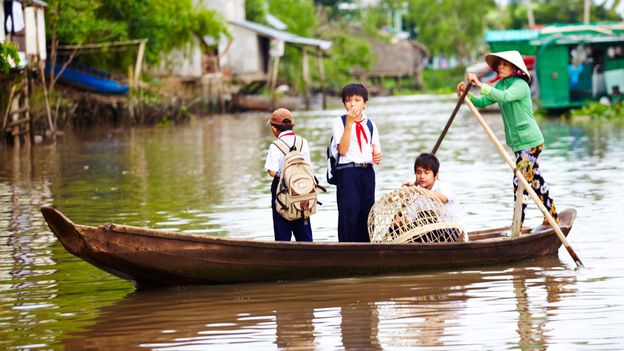
From the island-studded seas of the north to the meandering waterways of the south, Vietnam is a country defined by the diversity of its land and the generosity of its people.
From the island-studded seas of the north to the meandering
waterways of the south, Vietnam is a country defined by the diversity of its
land and the resilience and generosity of its people.
Halong Bay: Best for
coast
Once upon a time, a friendly dragon lived in the heavens above Halong Bay.
With invaders from the seas threatening Vietnam, the gods asked the dragon to
create a natural barrier to protect its people. The dragon kindly obliged,
performing a spectacular crash landing along the coast – digging up chunks of
rock with its flailing tail and spitting out pearls – before grinding to a
halt.
This scene of devastation is now known as Halong Bay –
Halong literally translates as ‘where the dragon descends into the sea’. Less
exciting explanations of this landscape involve eons of erosion by winds and
waves – but nobody disputes the splendour of the end result. Rising from the
shallows of the Gulf of Tonkin are thousands of limestone islands – towering
monoliths lined up like dominoes, some teetering at worrying angles.
‘In Vietnamese culture, dragons are the protectors of
people,’ explains Vo Tan, a guide who has been bringing people to Halong Bay
for two decades. ‘I once saw a picture of Halong Bay taken from above, and it
even looked a bit like a dragon.’
Sailing into Halong Bay, it’s easy to understand the
hallucinatory effect these strange shapes can have. The islands’ names testify
to the overactive imaginations of sailors who’ve spent too long at sea –
Fighting Cock Island, Finger Island, Virgin Grotto (which is said to contain a
rock the shape of a beautiful woman). Having largely resisted human settlement,
the islands have become home to other creatures. From above, sea eagles swoop
down to pluck fish from the waters, carrying their prey – still flapping – high
into the air, and squawking congratulations to each other from their nests.
Down below, countless jellyfish drift about the hollows that run beneath the
cliffs.
A local legend tells of another, altogether more sinister
creature lurking in the waters of Halong Bay. A gigantic sea snake and close
cousin of the Loch Ness Monster, the Tarasque was seen on three occasions by
19th-century French sailors, with sightings sporadically reported in Vietnam’s
tabloids since. I ask Tan who would win in a battle between the Tarasque and Halong
Bay’s famous dragon.
‘Of course the dragon would win,’ he grins. ‘In Vietnamese
stories, the good guys are never allowed to lose.’
Where to stay and eat
Most visitors to Halong Bay arrive as part of an organised tour sailing
from Halong City. Bien Ngoc Cruises offers
a spectrum of day trips and overnight tours, with many itineraries including
Titop – an island with outstanding views of the bay (two days from £60 per
person).
Hanoi: Best for city life
It’s rush hour in Hanoi, and the streets of the city’s Old Quarter
throng with hundreds of scooters. The pavement and the central reservation are
fair game in the chaos; zebra crossings exist more as a personal challenge than
a guarantee of safe passage. These are streets where Evel Knievel might have
written the highway code; where a grandma on a scooter will think nothing of
driving headlong into a tidal wave of oncoming traffic.
Hanoi is a city that refuses to grow old gracefully – a millennium-old
capital of crumbling pagodas and labyrinthine streets, now undergoing a
werewolf-like transformation into a 21st-century Asian metropolis. In the Old
Quarter, ancient temples now neighbour karaoke joints, and dynasties of
artisans ply their trade next to shops selling cuddly toys the size of grizzly
bears. Hanoi is a city that muddles up its past with its present – where a
statue of Lenin raises a clenched fist to teenagers who skateboard past him
every afternoon.
Few have studied the changing face of the city as closely as Do Hien, an
artist who has spent a lifetime painting Hanoi’s streets. He welcomes me to his
studio, and idly leafs through sketches of city life – couples waltzing beside
the willows of Hoan Kiem Lake, and alleyways where hawkers prepare steaming
bowls of pho.
‘Hanoi is a place that runs in your blood,’ Hien says thoughtfully, sitting
cross-legged among stubs of incense sticks and paintbrushes strewn across his
studio floor. ‘Had I not lived in this city I might not be able to paint like I
do.’
There are reminders of darker chapters in Hanoi’s past among Hien’s
collection. He began his career as a Viet Cong propaganda artist – applying
brushstrokes in between dashing off to fight the Americans during the Vietnam
War – and witnessed the bombing of his home town during Christmas 1972. He
shows me propaganda prints of anti-aircraft guns firing into skies above the
city, and a giant Vietnamese soldier grabbing an American B-52 bomber from the
air with his bare hands, King Kong style. Today, posters like these are in much
demand among collectors – yet Hien struggles to paint with the ferocity of his
younger years.
‘I can copy these posters technically, but I don’t have the right kind
of spirit,’ he says. ‘I try to remember what I was feeling, but I don’t have
the same anger any more.’ Like Hien’s artwork, Hanoi too has moved on. Hanging
beside his front door is an oil painting of Long Bien Bridge – to many locals,
the enduring symbol of Hanoi’s resilience. Blown to pieces by American bombs
forty years ago, the bridge has long since been patched up and repaired. It now
creaks under the weight of so many scooters passing through.
Where to eat
Little Hanoi offers good-value noodle and rice dishes in an atmospheric
dining room where birdcages dangle from the ceiling (main courses from £3; 9 Ta
Hien Street).
Where to stay
The Metropole,
now owned by Sofitel, dates back to French colonial rule over Vietnam, with
interiors that feature smoky wooden floors, glittering chandeliers and whirring
ceiling fans. Guests can also explore a rediscovered bunker, where staff and
residents sheltered during the bombing of Hanoi in 1972 (from £139).
Sapa: Best for
walking
An evening fog hangs over Sapa – a dense, B-movie fog, mingling with
smoke rising from bonfires on the valley floor. The clouds sporadically open up
a bit to reveal a village, a chunk of a mountain, a patch of jungle, before
obscuring them from view again, like stage scenery sliding into the wings.
Eventually the clouds lift, and the Hoang Lien mountain range emerges.
It is a landscape of extraordinary beauty – the Asian highlands half-remembered
from childhood picture books and martial-arts films. Above are peaks thick to
their summits with greenery. Below, rice terraces run down the hillsides at
right angles, as neatly as the folds in origami paper. Here and there, water
buffalo stumble about rice paddies, chomping on foliage and occasionally
looking up to offer gormless looks to passers by.
Sapa is a town where the weather seems to operate on random rotation –
switching between brilliant sunshine, thick fog, driving rain and occasionally
a dusting of snow, before coming full circle to brilliant sunshine, often all
within the space of a few minutes. A hill station settled by Vietnam’s French
colonists, Sapa now serves as a trailhead for hikers happy to run the
meteorological lottery of a walk in these mountains.
‘We have four seasons in one day here,’ explains Giang Thi Mo, my guide,
shimmying along the edge of a rice paddy as a rain cloud approaches. ‘There’s
no way to predict the weather – just be lucky!’
Mo may live in Vietnam, but she considers herself first and foremost a
member of the Black Hmong – a hill-tribe originally from southern China who
sought refuge in these mountains centuries ago. Black Hmong is just one of 53
minority groups in Vietnam – many of whom inhabit the country’s highlands.
Walking in these valleys entails packing a different phrasebook for every hour
of the trek. Close by are communities of Red Dzao, White Thai, Lu and Giay –
all tribes with cultures, languages and dress distinct from those of lowland
Vietnam, all equally well-practised at life lived on steep gradients.
We pass through a village, and Mo points to bamboo irrigation systems
that send trickles down the hillsides and into rice pounders that see-saw with
the current.
‘There’s a Hmong saying that “we flow with the water”,’ she explains.
‘It means we don’t worry too much, and take things easy.’
Dusk begins to settle on the mountains – bonfires are extinguished and
water buffalo herded homewards. The villagers around Sapa all plump for an
early bedtime. Very soon the valleys are engulfed in a profound stillness. The
blinking lights of fireflies cartwheel about in the gloom for a short while,
before disappearing from view, presumably lost in another thick fog.
Where to stay and
eat
Set over rice terraces a short drive outside Sapa, the Hmong Mountain Retreat has small
guest bungalows made from bamboo and thatched with palm. Set dinners (which are
often vegetarian) are served in a traditional Hmong house nearby. The owners
also offer trekking itineraries in the surrounding hills (from £37 per bungalow).
Hoi An: Best for
food
Hoi An is a small town that likes a big breakfast. As dawn musters
strength on the horizon, a small army of chefs sets to work on Thai Phien
street – firing up gas cookers and arranging plastic furniture on the
pavements. Soon, the city awakes to sweet porridges; coffee that sends a
lightning bolt of caffeine to sleepy heads; sizzling steaks; broths that swim
with turmeric, chilli and ginger. In Vietnam, street food is a serious business
– a single dish prepared day after day by the same cook, perfected and honed by
a lifetime’s craft.
‘Food in Hoi An is about yin and yang,’ explains Le Hanh, a young female
chef scrutinising vegetables at the morning market. ‘It’s about balancing hot
with cool, sweet with sour, salty with spicy.’
Carrying bags full of shopping, Le Hanh leads me to her cooking school
in a quiet backstreet of Hoi An, where she quickly sets about chopping up green
papayas and grilling fish in banana leaves. True to Hanh’s philosophy, cooking
in Hoi An goes big on contrasting flavours; food that plays good cop/bad cop
with the palate. The sharpness of fish sauce blends with the subtlety of fresh
herbs; cool lemongrass makes way for the eye-watering panic of accidentally
chomping on a red chilli.
Food tourism is nothing new to Hoi An. Japanese, Chinese and European
merchants sailed here in the 17th and 18th centuries, trading in silks and
ceramics and making off with sacks of spices, tea and sugar. Still standing in
the centre of the town is a Chinese temple to Thien Hau – the Goddess of the
Sea – with murals of her guiding cargo ships homeward through stormy seas.
The port’s fortunes waned, and Hoi An has long since slipped into a
state of graceful dishevelment. Today, purple bougainvillea springs from
mustardcoloured warehouses where merchants once kept their goods, and the teak
and mahogany shutters creak on their hinges. Wire birdcages hang from the
branches of tropical almond trees – pet pigeons, grackles and turtledoves
cooing and trilling inside. It looks like the Orient as imagined in Graham
Greene novels – a backdrop to period dramas involving khaki suits and grim
telegrams from London.
The merchants who brought Hoi An its fortune have long since departed,
but their presence lingers on in the town’s gastronomy. Hanh reaches for a
plate of cao lau – a noodle dish thought to have been inherited from Japanese
and Chinese merchants, but which purists insist should only be made using water
from a particular well in a backstreet of Hoi An.
‘In Hoi An, we cook food from all over the world,’ says Hanh. ‘We just
make it better.’
Where to eat
Set in a French colonial building with an ornate façade, Lantern Town serves up numerous local
specialities. The upstairs balcony has waterfront views (from £3).
Where to stay
Actually nothing to do with the sport, the Golf Hoi An Hotel offers large rooms with
dark-wood furniture, air conditioning and balconies overlooking a central
swimming pool. From the hotel it’s roughly a fifteen-minute walk to downtown
Hoi An (from £30).
Mekong delta: Best
for river life
A heavy rain is falling on the Mekong Delta, flooding the footpaths,
swilling in the gutters, turning riverbank mud from light tan to a rich coffee
colour. In the villages, everybody runs for cover – men, women, infants, enough
animals to fill Old MacDonald’s Farm: chickens, geese, dogs and cats, all
scurrying under iron sheet roofs and looking hopefully up at a slate-grey sky.
It is the rainy season, and ‘water, water everywhere’ might be the job
description for the Mekong Delta. A tangled network of rivers, tributaries and
canals, the waters of the delta criss-cross the lowlands of southern Vietnam,
before emptying out into the South China Sea through mighty, yawning estuaries.
For centuries, life here has ebbed and flowed in tandem with the current of the
Mekong – an all-in-one launderette, bathtub, highway, toilet, dishwasher,
larder, social club and workplace for the communities surrounded by its waters.
‘If you live on a river island with twenty other people you have to
learn to get along with everyone,’ explains Mrs Bui Nguyen, beckoning strangers
to shelter in her bungalow beside the Cai Chanh canal. ‘That’s the reason why
people in the Mekong are so friendly!’
A 77-year-old who attributes her longevity to a lifetime avoiding
doctors, Mrs Nguyen wistfully reflects on the delta of old – in days when the
only artificial light came from peanut oil lamps dotted along the riverbanks;
an age long before roads had reached the villages.
Times have changed. However, human life still instinctively congregates
on the water’s edge. Lining the riverbank nearby are grocers’ shops, cafés, a
gym, a billiards club and a blacksmith’s, whose owner makes kitchen utensils
from helicopter parts left over from the Vietnam War. Floating markets, too,
are still held every morning at nearby Cai Rang – with creaking barges from
across the delta bashing into each other as they offload cargoes of
watermelons, pineapples and turnips.
The rain eases, and the rhythm of delta life slowly begins to gather
pace – sampans cast free of their moorings, children arrive home from school on
ferry boats and mud skippers hop along the riverbanks. Setting out downstream,
the Mekong seems a place of Eden-like abundance. Rafts of water hyacinth drift
along in the current, spinning in the eddies. Skirting the riverbank are shady
papaya groves, banana trees bent double under the weight of their fruit and
palms that seem to bow deferentially to the boats that pass by.
Swollen with rainwater, the river seems to quicken as we round a bend.
The current tugs at boats tethered to wonky jetties – seemingly inviting them
to join the river in its procession onward through the delta and into the sea.
Where to stay and eat
A popular option for travellers in the Mekong Delta, homestays see
guests staying with local families and helping them cook dinner. One of the
best is the Hung family homestay, close to Can Tho, which offers hearty food
and simple bungalows set along a quiet riverbank. Excursions to the floating
market nearby at Cai Rang are also available (00 84 90 384 9881; stay from £7
per person, including dinner, excursion £5 per person).
Source link